Tuesday, May 7, 2024

A Raven Welcome


About a week ago, I took my two dogs Rosie and Henry for a walk in what used to be the Strawberry Hill Nature Preserve and is now part of Michaux State Forest. A few years back, Rosie and I used to hike these trails several times a week (she and I were both younger then . . . ), but now we only get out about a half dozen times a year. Don't worry, we haven't stopped walking but rather have opted for other closer locations, of which there are many here in Gettysburg, Pennsylvania.

Whenever we do get to our forest trails, we're often greeted by a Common Raven.  I kid you not. It seems incredible to me, as if this raven knows me and the dogs, that somehow we're special. While this preserve/forest is not a high traffic place, I'm sure dozens of people each weeks walk its trails.  So, I wonder: Do they get the same reception?  

No sooner do the dogs and I enter the forest then the familiar Kronk, kronk, kronk, kronk! greets our ears. And I stop to see if I can see him or her flying overhead, though I seldom do. But you don't need to see a raven to identify it, that is, if it's calling out to you. 

Want to hear a raven? Just do an online search on "Call of the Common Raven,"  you'll get lots of videos.

Want to see a raven in the "wild"? Well, you guessed it--get yourself to a forest, a coniferous one or one with coniferous trees.  In fact, the raven that greets us has a roost in a large grove of American Larch trees. Unlike most confers that are evergreen, the American Larch is a deciduous conifer; it looses its needles in the fall.

Currently I'm writing and illustrating a chapter book serial series of seven books called The Bird Club. In book four (The Three-Cedar Secret), which I'll be publishing in July 2024,  the common raven plays a significant role.  Since I've no photo to share, here's my illustration of a Common Raven, one you'll find the upcoming book. If this bird looks big to you  that's because it is big, with a wing span of four feet.  The bird depicted is more than a "common" raven but, then, aren't they all?

Till next time!


Monday, October 30, 2023

Red-wing Serenade

Just back from a walk with my dog Henry to the Emmanuel Harmon Farm (Gettysburg, Pennsylvania) where we were serenaded by two separate flocks of red-winged blackbirds. As you likely know, blackbirds congregate in the fall to feed together in wet fields and woods and along riparian corridors. And that's exactly where found our flocks today.

A large flock of red-wings were singing and calling from the trees along Willoughby's Run. This is where Henry and Rosie (who could not join us today because of her achy joints) like to take refreshing dips in the water. And this is where Henry and I enjoyed their sunny sounds on this cloudy day. (By the way, here's an image I took of a red-wing some dozen years ago.)

 Red-wings are known for their exuberant song  of conk-la-ree!  It's highly recognizable and joyful with hundreds of birds all whistling, sputtering, and trilling. Wow!

I look forward to their next musical engagement.  

Till then, keep birds in your heart! And check out my chapter book and middle-grade series of fiction that all celebrate birds!  https://www.pkbutler.com


Sunday, August 6, 2023

A Long Wait for the Great Egret


The last time I saw a Great Egret on Marsh Creek was in October of 2021. Since then, I've been waiting to see one. Well, finally, one week ago I did though this egret took flight and I had no camera. (On a prior outing, I lost my footing in the creek and got a good soaking along with my binoculars and camera. I still need to buy a new camera). The photo provided here is one I took in 2021, also on Marsh Creek.  (See additional photos in my post of  August 1, 2021.)

Based on my sightings in 2021, my sense is that these egrets are/were breeding here despite the fact that the Pennsylvania Society of Ornithology's range map doesn't include Adams County as one in which the Great Egret breeds but rather migrates through. That said, three counties directly north of Adams are indicated as breeding locations as well as several due west of York County, our neighboring county to the west.  For this reason, I suspect that egrets are breeding here, too. And isn't that a nice thought?

Of course, by the end of October, the egrets will have flown south to their wintering grounds, but while they're here, I hope to enjoy their company.  And today seems as good as any to seek one or more out! 

Till next time . . . Keep birds in your heart!


Wednesday, June 14, 2023

Common Yellowthroats Are Hardly "Common"


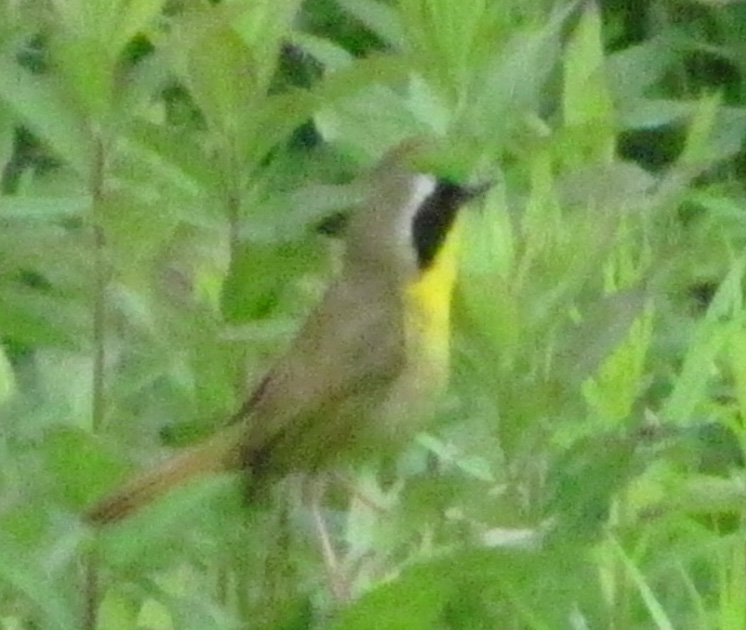
Today I saw (and heard) the distinctive looking and singing wood warbler, the Common Yellowthroat.  (Here's another grainy photo of mine taken no less than a dozen years ago--ha!) I was walking downstream with my two large dogs Rosie and Henry on Marsh Creek, here in Gettysburg, Pennsylvania. 

I first heard the song of the male, which is easily identifiable. It sounds something like witchity, witchity, witchity. But birds don't always sing their songs loudly and fully. For instance, sometimes, when they're feeling a bit tired or uninspired, a bird might sing a partial phrase, like "ity, ity" . . . as in the case of this particular yellowthroat. 

I kept hearing phrases, like scattered puzzle pieces not "snapped into place."  You can imagine my delight when a bird flew from the bushy undergrowth by the creek bank onto a lower, dead branch of a tree to perch long enough for me to get a good look at him! Thank you, Dear Yellowthroat. You are an exceptionally attractive bird with your bright yellow breast and black mask bordered with a white head band. Don't ever believe that you're "common"! Far from it!

If you love birds and enjoy reading fiction that highlights them, then visit my web site for information on my middle-grade trilogy Of the Wing.  By the way, many an adult likes them, too!  Here's hoping to see you there!

https://www.pkbutler.com

Till next time . . . Keep birds in your heart!


Wednesday, May 3, 2023

My May Day Meadowlark (known otherwise as the Eastern Meadowlark)

Today is May 3, and I'm still tickled by a rare sighting of the Eastern Meadowlark on the first of May known by some (like me) as May Day.  May Day is a big deal to me as I associate it with the time of spring warblers filling the woodlands. Warblers are wonderful, as you well know, but if you've ever heard the song of an Eastern Meadowlark, you know that warblers have serious competition.

The habitat of the Eastern Meadowlark is field and pasture, and when I lived in Clearfield County, Pennsylvania, I saw them regularly every spring and summer.  My house sat in a hollow, which was surrounded on three sides by forest and one side by a 30 plus acre of pasture. The last and only time I ever got photos of this beautiful songster was in the summer of 2011, my last year of life in that birder's paradise. 

As always, I must apologize for the quality of my photos. I wasn't a photographer then and I'm still not--ha!

If you want to see the Eastern Meadowlark in its full glory, just pop the name into your search engine. 

This once common bird is in steep, steep decline, so much so that to see or hear one is a lucky event especially if you don't live in a rural location. I currently live in Gettysburg, Pennsylvania, home of the Gettysburg Military Park, and so field and pasture abound. And every spring and summer, I've imagined that when driving along Emmitsburg Road, I've heard Eastern Meadowlarks. Unfortunately, I could never spot one.

Then on May Day, while driving on South Confederate Avenue, I heard an Eastern Meadowlark. I


pulled into the lane of the Bushman House (a historic home and property of the Battle of Gettysburg), and, with my two dogs, walked (they ran) through the pasture and orchard to locate the source. And then I found him! He was sitting within a peach tree calling out for mates.  The Eastern Meadowlark (who in truth is not a "lark" but a blackbird) is a busy guy who mates with two, maybe three ladies! And given their population decline, I say "Bravo" to that!

Until next time . . . Keep birds in your heart!


Monday, March 27, 2023

Blue-gray Gnatcatcher Always Catches My Fancy


Public Domain photo provided by the National Park Service.

I saw and heard my first Blue-gray Gnatcatcher of the season at a local nature preserve, Strawberry Hill. I've heard (and sometimes seen) her for many years during my short hikes with the dogs and, usually, in the same area near the woodland's edge and adjacent to a large pond. 

She's a tiny, slim bird with a long tail, so when I saw the silhouette of just such a bird on a small branch above me, I suspected the Blue-gray, though she was obscured in shadow. Then, when I heard her tell-tale song, "spee, spee, spee," I knew with confidence who had graced my path.
(I tried to catch a photo, but, alas, she would not wait. Trying to locate these active birds is difficult enough let alone photographing one.)

Only last year I somewhere read an apt description of this gnatcatcher as a tiny Mockingbird. At the time, I thought it related specifically to her plumage and tail. Now, I discover that the Blue-gray has two song types--the one I identify her or him by (spee, spee, spee) and another, more complex song, as described on the web site allaboutbirds.org (sponsored by the Cornell Lab of Ornithology):

"More complex songs are sung from early morning to midday. These continuous jumbles of sharp chips, high-pitched whistles, and mewing notes are 10 seconds or more long and often include mimicked bits from the repertoires of jays, tanagers, towhees, vireos, warblers, sandpipers, and other species."

I didn't know . . . but now I do!

There's a world of wonderful information to learn about our world of wonderful birds. Here's wishing you  good fortune in birding and seeking!

Till next time . . . 

Friday, February 17, 2023

Great Backyard Bird Count: February 17 - 20

 Hello All! 


Once again the Great Backyard Bird Count (or GBBC) has sneaked up on me. I've two sisters with birthdays around these days, so I'm always distracted with birthday preparations. Luckily, to participate, you need offer no more than at least one bird watching event for 15-minute minutes or longer. Of course, participating every day during these four days would be great, too!

To learn more about it, check out the GBBC web site:

https://www.birdcount.org/


I just invested about 20 minutes recording the birds coming to my bird tray loaded with black-oil sunflower seeds. I won't both you with the specific counts on each, but here's a list of the visiting bird species. And here's a blurry photo (sorry) of a White-breasted Nuthatch and a male House Finch.


House Finch

American Goldfinch

House Sparrow

Downy Woodpecker

Red-bellied Woodpecker

Dark-eyed Junco

White-breasted Nuthatch

Northern Cardinal

Blue Jay

Tufted Titmouse

Black-capped Chickadee


Here's hoping you can join the GBBC of 2023! Until next time . . . .


Sunday, January 8, 2023

Red-tails Abound in Gettysburg, Pennsylvania


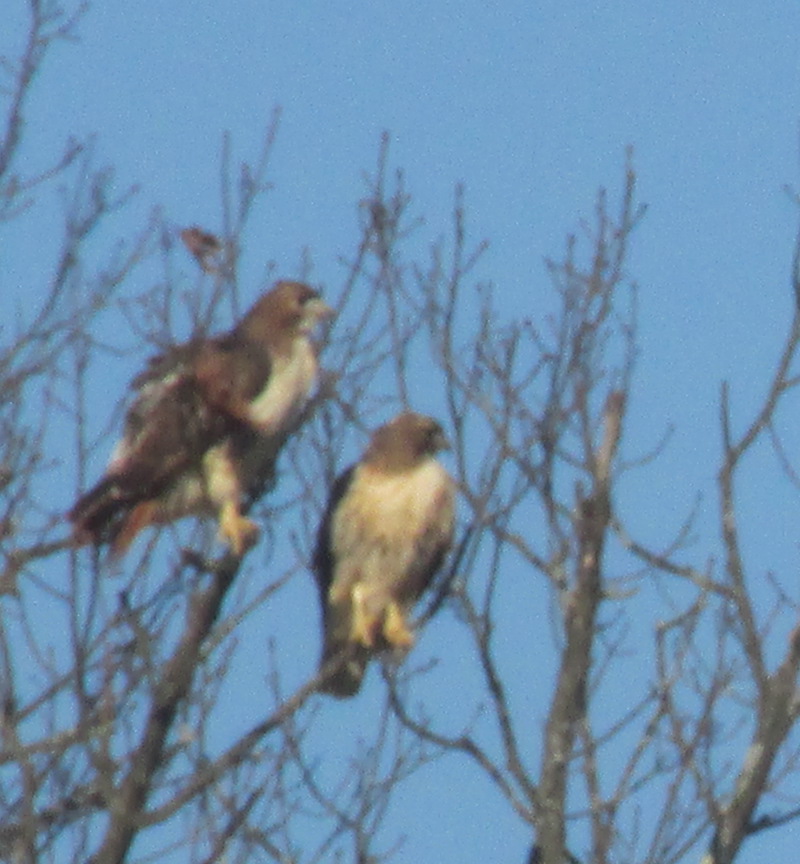
I live in Gettysburg, Pennsylvania, where almost everyday I see Red-tailed Hawks, the most common of all hawks in North America.  I saw this one perched high in a tree behind the Bushman House, a historic farming property on the Gettysburg Battlefield. 

As the most prevalent hawk, red-tails should be your first guess when sighting a perched hawk or one soaring in the sky. If the hawk has a white chest, white belly, and a "belly band" of striped markings, as this one, then the identification is complete: Red-tailed Hawk. You can be confident of this identification everywhere in the eastern states. 

Of course, the mature adult can be accurately identified by its rufous or red tail which can be seen from below when the hawk soars overhead, especially when aglow with the sun. However, the tails of immature hawks are brown with darker bands. Therefore, using tail color alone is not the best option when identifying this hawk. Additionally, red-tails will always (whether juvenile or adult) display dark patagial strips on the leading edge of the wing. When seen against the light underbelly of the hawk, these markings from head to wrist are conspicuous and another determining feature for identification of the red-tailed hawk.


To my great delight, this hawk was quickly joined by another! These might well be a mated pair, though it's difficult to assess their sizes (females are larger than males) given their separate perches. 

Here's wishing you all a wonderful New Year in 2023 with many fortunate sightings of the Red-trailed Hawk!


Tuesday, December 6, 2022

Birding with Dogs . . .

Birding with dogs is not easy unless, I guess, you're birding by ear.  But I'd argue that my two dogs, Rosie (the lab) and Henry (part border collie, part pointer) can even distract me from birdsong. You see, my dogs assume our outings are devoted to their exercise, exploration, and fun! Meanwhile, I delude myself into believing that I can also, on occasion, raise binoculars to a bird or--if the Fates allow--even snap a photo. What a joke. Try aiming your camera on a Great Blue Heron rising from pond or lake while leashed to 140 pounds of dog (combined weights). Inevitably, the critical shutter "click" gets preempted by an important canine message: "Let's go this way!"  And away I am swept.

The obvious solution is to untether myself from the dogs. And, I do, but the general public does not look favorably upon a free-roaming pack of dogs . . . okay, two dogs do not a "pack" make . . . but you understand. Even then, my radar must be scanning for unsuspecting walkers, bicyclists, or Heaven forbid--other dog walkers!   While human strangers usually know protocols for passing one another on trail or path, the same cannot be said of canines.  Merge unleashed dogs willy nilly and mayhem will result.

So what to do?


Go birding without the dogs. Ahhh! That's it! I'll leave the dogs at home, but . . .  I'm not sure they'll let me.

Until next time . . . Keep birds in your heart even if you can't photograph them. 

p.s. The image to your right is not a seal. It's a happy, wet dog.


Wednesday, October 5, 2022

Amazing Encounter with a Juvenile Red-tailed Hawk

(Image is one taken by me a couple years ago of a Red-tailed Hawk.) 

At around 11:00 am a juvenile red-tailed hawk slammed into my living room window. I rushed out of the house to find it stunned, lying on the ground, with my cat Ursula warily approaching. I scooped up the raptor whose one claw grasped a twig and carried it alongside the deep yard, repeatedly saying to myself, Oh my God, Oh my God, Oh my God!  I had never held a raptor, let alone the species of Red-tailed Hawk who is a main character in my trilogy Of the Wing. To be given this experience was humbling, especially since the hawk appeared only to be stunned and not severely injured. His subdued condition lasted about two minutes before he flew from my hands and across the yard into a black locust tree.


As I write this 30 minutes later, I am still overwhelmed and feeling so blessed by the experience. I see it as a message from Spirit. The specific message is of my private concern, but the larger message is one I must share: Look not only to other people for answers to life’s questions but also to Nature and her children, for we are all one community.


Until next time . . . Keep birds in your heart and wonderful things can happen.

Wednesday, August 24, 2022

Eastern Kingbird Reigns Over my Yard

I enjoy sitting far out in the backyard to watch the birds fly in and out of my neighbor's dying Ash tree.  Don't get me wrong, I don't enjoy seeing the ash tree die, but lots of birds appreciate dying trees, especially woodpeckers.  Other birds like flycatchers enjoy the clear line of sight of provided by high, dead branches. In recent weeks, I've watched Eastern Phoebes and Wood Pee Wee's fly out from these perches to catch an insect "on the wing" and then return again to their post. Even Red-headed Woodpeckers, who also catch insects in mid-air, have visited this tree time and again. 

But this entry is about an Eastern Kingbird, one I saw on August 2 (yes, I'm late to post). I don't typically see the Kingbird, not in my backyard, so I took note as he flew from the popular ash toward dead limbs poking above some cedar trees. He sat there just long enough to let me catch this one image.  

Kingbirds have a reputation for being aggressive with other Kingbirds and birds, generally, during the breeding season, which I can definitely vouch for having seen two Kingbirds "slug it out." I'm inserting here an excerpt from my July 2011 post on the topic (yes, I said 2011 . . . I've been posting here for a long time):

"Then an intrusive shrieking filled the air as I watched two kingbirds, descending from above, wrestle in the air before me, about twenty feet away. A duo of furious flapping wings, they spun, descending through the air like a tiny tornado until one dropped, falling six or seven feet into the tall, thick bank grasses. Mesmerized I watched as the fallen kingbird flopped and flapped within the grass while my black lab Bridget rushed to investigate. “No, Bridget!” I demanded, my tone giving her reason to pause as the kingbird found its bearings and lifted into the air, flying toward a towering Norway Spruce. "

No wonder, they're called "Kingbirds" because they're in control! And, of course, they're regal in appearance with a white underside, a dark backside, and a neat white trim to their tail.  Oddly enough, these insect-eating combatants become quite friendly with one another once they return to their wintering grounds in South America, where they enjoy socializing in large flocks and supping on succulent fruits. I guess it's hard to be "hard-headed" on vacation. 

Until next time . . . Keep birds in your heart!

Sunday, July 10, 2022

Red-headed Woodpeckers: My Summer Guests

On July 1, 2022, I had the good fortune to watch four Red-headed Woodpeckers (three adults and one juvenile) feeding in the sky above my backyard. Like most woodpeckers, red-heads hammer tree trunks for insects but can also catch them midair or “on the wing.” 

My visitors mostly perched on the high and exposed dead limbs of two black locust trees. From here they alternately swept into the air, catching this or that unsuspecting insect and promptly returning to the same or a new perch. I watched their aerial exploits for about twenty minutes before the group decided to move on—but not before I was witness to one adult feeding the juvenile. I did get a photo of the pair though not of the food exchange.  


Then, on July 4, two red-headed adults returned to my yard. Again, I grabbed my binoculars and sat down on the deck to enjoy the show. Today is July 10 . . . and I’m wondering if any or all will come back soon!


Till next time . . . Keep birds in your heart.

Wednesday, June 15, 2022

Red-Shouldered Hawk: Third Time Is a Charm


Today I took my two large dogs for a walk downstream on Marsh Creek (here in Gettysburg, Pennsylvania). I always see these "water walks" as mystical because of the many birds we see, including Great Blue Herons and Great Egrets. But today, as we entered the creek we were greeted by a Red-Shouldered Hawk. Maybe "greeted" isn't the best word as he severely scolded up before flying away from the snag (a dead tree) from which he was fishing. Yes, fishing. Though small mammals are the meal choice of this hawk, it will take a fish if it can. Why else would red-shoulders hang out in riparian environments?

NOTE: Hawk pictured her is my photograph but not from today's sighting. 

Despite our rude reception by the hawk, who flew off, I knew that today's walk would be magical. The hawk seemed to promise us a lively reception down creek. At so it was. We heard and/or saw many house wrens, red-winged black birds, catbirds, crows, flycatchers, one solitary male mallard, and many others. But what most surprised me was that on our return trip up creek as we neared our exit location, who should be waiting for us? You guessed it--the Red-Shouldered Hawk!

More amazing still, as we climbed from the creek bank and through the road-side vegetation to access the quiet, No Outlet road, who do you think would provide us one last look . . . this time flying through the sky in the near distance?

I don't know if you believe in "signs" or omens, but I definitely do! And these three encounters with the Red-Shouldered Hawk was nothing less than a mystical charm.

If you'd like to learn more about me, an author who writes fictional stories featuring bird themes, check out my web site:

https//www.pkbutler.com

Until next time . . . keep birds in your heart!


Wednesday, May 18, 2022

A Pileated Woodpecker Poses for My Camera


 Yesterday I took my big dogs Rosie and Henry out for a swim on Marsh Creek here in Gettysburg. (I won’t say exactly where because we’ve adopted the area .) Though I call myself a “birder,” I suppose I’m first a dog-walker and then a birder since I never go walking or hiking without the dogs. That said, birding isn’t easy with dogs along. 

Even so, I was lucky enough to spot an obliging Pileated Woodpecker who posed for at least two minutes while I fumbled with my camera. Most birds take flight as soon as you “eye” them, but not this crow-sized woodpecker, the largest species of woodpecker in North America if you don’t include the Ivory-billed, deemed extinct by most authorities but not all. (In fact, though no birding authority, I belong to the hopeful group, the one that insists that . . . the “The Ivory-bill is out there.” In fact, I even wrote about this elusive bird in book two of my trilogy Of the Wing.)


But back to the Pileated. This woodpecker is conspicuous for his large size and flaming red crest. The male (pictured here) also has a red cheek stripe that the female lacks. Otherwise, white facial stripes run down their necks. When hugging a tree trunk, the Pileated appears mostly black, but in flight the underwings are mostly white while the upper side of the black wings are traced with white moon-shaped crescents.


Pileated Woodpeckers pound the trunks of dead and dying trees with their thick pointed bills in search of hollow cavities containing carpenter ants and other insects, but they also eat fruit and nuts. You can identify a Pileated’s handywork by the size and shape of his/her holes—large and rectangular. Otherwise, these woodpeckers drill circular openings with deep holes for nesting. Then, after the kids “leave the nest,” other birds . . . or even bats . . . can move in! That’s what I call hospitality.


Until next time . . . Keep birds in your heart . . .  and check out my middle grade trilogy Of the Wing at  . . . 


https://pkbutler.com

Wednesday, March 23, 2022

Ring-necked Ducks Searching for a New Name


This morning I took my two dogs out for a walk on the Emanuel Harmon Farm where we spotted four Ring-necked Ducks (three males and one female). These ducks are notorious among birders for having the wrong name. For instance, can you identify a ring around the neck of males pictured in these photos? True, the photos are a bit fuzzy (I'm not a photographer), but trust me, you'd be hard pressed to find the chestnut or cinnamon band even in a sharp image. The light and angle of such a photo has to be just right.

 If one marking IS conspicuous with these ducks, it's the white ring around their bills, in both male and female. (In recent years, the American Ornithological Society reviewed a proposal to change this species name but declined.) But enough on this rant--ha!


The drake has a glossy black head and back and handsome gray sides, punctuated with white shoulder patches. A real classy guy. What lady (or hen) could resist such a fellow, especially with his dreamy deep golden (or orange?) eyes. However, the hen has her own bragging rights with burnished brown sides nicely contrasting her grayish brown back. And who doesn't love white eye rings? 

Ring-necked Ducks are diving ducks, but this species doesn't plunge too deeply for their meals. In shallower ponds, just a few feet will take them down to where the leeches hide in the murky mud and submerged vegetation. They also like snails, earthworms, dragonfly nymphs--you name it! Most aquatic invertebrates will do. They also snack on submerged plants and tubers of various kinds, including water lilies. 

Ring-necked Ducks are mostly migrants, flying through Pennsylvania to their breeding grounds throughout Canada and northern North America and then flying south to winter in our southern and western states as well as Central America and the Caribbean. That said, you'll find Ring-Necked ducks wintering in a few southeastern counties of Pennsylvania as well as Erie,  our state's most northwestern county. Go figure.

As I live in Adams County, I think myself lucky to have spent some time with this migrating  band of diving ducks. Good luck on your journey!

Until next time . . . Keep birds in your heart!

Wednesday, January 19, 2022

Close Encounters of a Blue Heron Kind

This is an image taken by me (April 2011) of a heron at my pond.

About 10:00 am this morning, I was driving home with my two dogs after a good walk around the 100-acre tract of what used to be the Gettysburg Country Club and is now a part of the Gettysburg Battlefield. Along Mummasburg Road to my right, I spotted a Great Blue Heron who appeared to be hunting fish in a roadside culvert. On approach of my car, the heron flew up and over the road before veering back to the pasture, where he flew low to the ground directly alongside us.  The heron flew for such a good stretch, maybe a hundred feet, that it seemed we were being escorted. When the long-legged wader finally settled to the ground, my sense was of an old, hunched man, cold and hungry. 

Once home, I visited my ‘go-to’ web site for information on the birds of Pennsylvania to see if this heron had “missed the bus” in heading somewhere warmer for the winter.  That site is    https://www.pabirds.org


and hosted by the Pennsylvania Society for Ornithology. There I followed the menu tab for ‘Birding’ with a dropdown menu that takes you to a running list of all the birds of Pennsylvania, including resident birds (year-round), breeding birds, wintering birds, and those migrating through. A color-coded map is provided for each bird, and here’s a screen capture that tells the story of my cold and hungry heron. 


While most of the state welcomes heron for breeding (red area), apparently a few southeastern and southcentral counties (including Adams) host herons in the winter! I didn’t know this but am glad to know it now, because it means that this heron most likely knows what he’s up to, after all.


Till next time . . . Keep birds in your heart.

Saturday, January 1, 2022

Belted Kingfisher: Punk Rocker of Birds

I have a confession. (What a way to start the New Year!). I am reporting today, January 1,


2022, on a bird that I spotted on 12/10/2021 (three weeks ago). Also, the images presented here were taken of a kingfisher that I photographed more than ten years ago. What can I say? That I’m a procrastinator? True. Maybe I can work on that in 2022. That I’m not a photographer. True. I’m more a dog walker than a photographer. I sometimes carry a camera but seldom catch the image of a fast-moving bird and this kingfisher was fast as he/she flew from the bank of the pond to a bush. By the way, I did get the bush—ha!


But enough of me. What about this Belted Kingfisher?


Even though I couldn’t get a good look, I knew the bird by his/her vocalizations, to my ear, a clicking rattle sound reminiscent of an antique tin rattler (look it up on Google). But louder, much louder, which is part of the rationale for my heading: “Punk Rocker of Birds.” You can say that a kingfisher makes a lot of racket. (Please forgive me, punk rock fans). The other rational for my “punk” label is this bird’s “rad” crest (am I using this adjective correctly?).


The admittedly dark photographs
are of a male (who has a blue-gray breast band) while the female has both a blue-gray breast band AND a chestnut belly band. You can see good images at allaboutbirds . . . and while you’re there, check out the audio to see if my interpretation rings true.


https://www.allaboutbirds.org/guide/Belted_Kingfisher/id


If you take the time to review all the information provided, you’ll find more than one interesting fact, but here are two in case you’re too lazy to bother. Belted Kingfishers catch fish by diving headfirst into the water and grabbing their prey with that super big bill. Another use for his bill is to help prod the ground that he burrows out with his front claws to create an underground nest, usually within the bank above a pond or creek. But you can get all the details at the link above. 


Here’s wishing you all a Happy New Year in 2022!


Until next time . . . Keep birds in your heart.

Thursday, December 2, 2021

I Happen by a Northern Harrier


To start, let me say that the photo presented is not mine but one by 
Walter Siegmund (C) 2006 and used with permission.* I was driving south on Mummasburg Road (Gettysburg) past fallow farm fields when I spotted her, a bird of prey that breeds in Canada and in northern parts of the US, wintering in much of Pennsylvania. Each year, as the weather gets cold, I've spotted the Northern Harrier flying over these same fields. It's always a thrill because although their occurrence in my area is "regular," sightings are "uncommon."

The harrier is dimorphic, the male being of a slate gray (even bluish color) and the female, brown. Both have white rumps (a distinguishing field mark) and black tipped wings. This bird of prey has long, wide wings and I can usually distinguish it from hawks by its flying habit low over the ground, whereas certain hawks perch atop poles or dead tree limbs and swoop down upon their prey once sighted. The harrier, instead, flies over in reconnaissance mode.

The harrier will often hover over its potential prey,  treading air, before making the plunge. If you're wondering what makes a harrier a harrier and not a hawk . . . I too wondered about that at some past point and learned that the harrier has a facial disc much like an owl (which the hawk hasn't). This facial disc captures sounds from the ground that  helps the harrier locate his or her prey.

I've had several intriguing sights of this impressive bird, one that I reported on in this blog back in 2010. That sighting of a beautiful male so impressed me that his description and behavior found its way into the third book of my middle grade  trilogy Of the Wing titled The Shining Swan. You can learn more about ti and me at 

https://www.pkbutler.com

Until next time . . . keep birds in your heart.


Friday, November 12, 2021

Mallards Undercover

A few days ago, the dogs and I headed out to one of our favorite walking locations, the Emmanuel Harmon Farm, now part of the Gettysburg National Military Park. In year past, these 100 acres hosted the Gettysburg Country Club with a 9-hole golf-course. But, happily, nature and local wildlife have reclaimed these grounds, which also provides walking paths for people (with or without dogs).

A central pond, installed for the golf course, provides a layover for various waterfowl, including the Mallard. Easily the most recognizable and common duck in Pennsylvania, Mallards might be under appreciated by some, but not by me. The breeding male mallard is simply stunning to behold with him iridescent green head (which can appear purple under certain light conditions) and bright yellow bill. Too, he wears a tidy white collar that contrasts beautifully with his chocolate breast—a very dapper dabbler!


The female, though not so showy, is also quite beautiful under closer inspection, her plumage a weave of buff, browns, and cream—a lovely tapestry of color. Too often, the female is dismissed with descriptions of “mottled brown” or “drab,” descriptions to which I take offense!  Consider the beautiful iridescent blue speculum patch, trimmed in white, within the secondary wing feathers (also an ornament of the male).


So . . . next time you see mallards on a pond or lake, show them some respect. Take a longer look. I wasn’t lucky enough to capture photos displaying their glory. Perhaps they weren’t in the mood to pose that day.  More likely I was too distracted with Rosie and Henry, per usual. Whatever the case . . . there’s always tomorrow.

Finally, if you love birds and want to read a middle-grade trilogy about a adolescent girl with a mystical tie to birds, then check out my web site:

https://www.pkbutler.com

Until next time . . . Keep birds in your heart!

Thursday, October 21, 2021

The Yellow-billed Cuckoo: A Long Time Coming to Me


The last time I saw a yellow-billed cuckoo was many years ago when I lived in Clearfield County, Pennsylvania. I was a fledgling birder out with a few experts who were conducting a bird count. One of the birders identified the call of the yellow-billed cuckoo, who was quickly spotted. And we all focused our binoculars on the sleek, graceful bird known for eating the “hairy” caterpillars unappetizing to most birds. Knowing little at the time on the populations of birds generally, I imagined that cuckoos were rare, exotic birds and counted myself lucky to have seen one.

 Since then, I’ve not seen or heard another cuckoo . . . until two weeks ago. And it took me some seconds to translate his image into one I recognized from so many years before. Wow! I thought—and hurrying home checked the web site of the Pennsylvania Society of Ornithology (pabirds.org) to check on the status of this bird. I was amazed to find that the yellow-billed cuckoo is a “fairly common” breeder (summer resident) and migrant of not only Adams County but the entire state. Who knew? Certainly not me.


I believe that you can’t see what you’re not looking for. In other words, because I never expected to see another cuckoo, I never did. But on October 6, 2021, I saw one! And perhaps both my eyes and mind opened to their reality because, just six days ago, I saw another.


This second sighting was on (in) Marsh Creek, where I take my two dogs for


creek-walking and swimming.  This yellow-billed cuckoo allowed me a good, long look, so long that I almost—almost—got my camera in position to take a photo. But at the critical moment, my two dogs came splashing up the creek and scared him or her off. So, I offer you these two beautiful public domain images, one from wildlife painter and illustrator Robert Bruce Horsfall (1869-1948) and one a public domain photo. Oddly enough, “my” cuckoo was similarly posed as in the illustration. I clearly saw his yellow bill, cinnamon “wash” of his wings, and the conspicuous yellow circles of his tail. 


Here’s hoping that next time, I’ll hear his or her distinctive song or calls. Listen to them at allaboutbirds.org.  Finally, if you love birds and want to read a middle-grade trilogy about an adolescent girl with a mystical tie to birds, then check out my web site:


https://www.pkbutler.com